




Deciding between home life and hostel life at the residential school, which is better than the other, is mainly subjective. Yet, in both cases, certain realities are unchangeable. For some, nothing beats the comfort, luxury, and warmth of home, be it home-cooked food, comfort, or emotional support that one gets from the family living under the same roof.
For some, a residential school is a place where students can develop their personalities and character constructively, learning about their abilities and adapting to different cultures, ethnicities, and surroundings. Naturally, sending a child to a hostel or a residential school is a big decision for parents, who often worry about their child not being able to adjust to the changes.
Yet, whether it’s hostel life or home life, both come with two very different sets of advantages and challenges. In this blog, let’s decode which life is better than the other, so you feel clearer and confident about the choice ahead.
Table of Contents
Life At Home
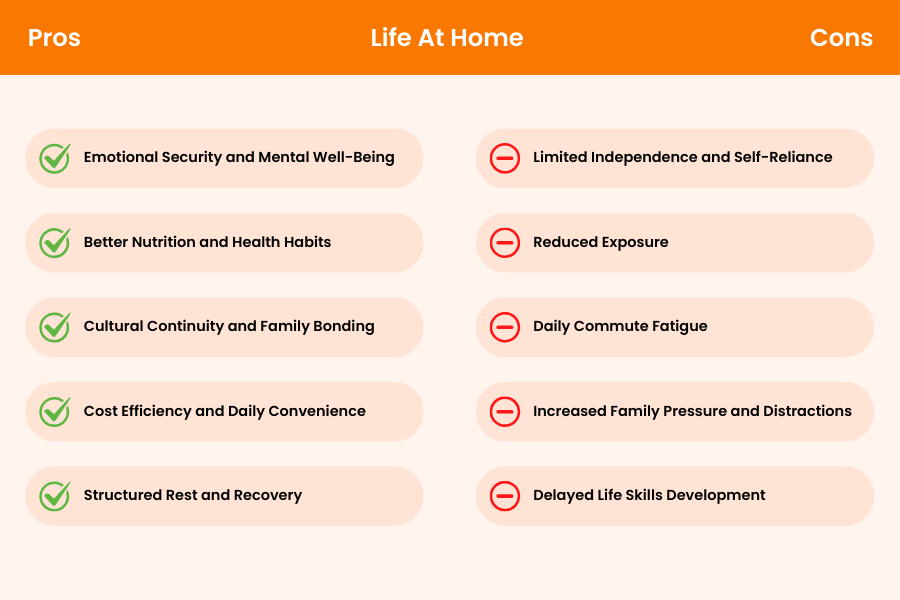
In India, where family ties are deeply rooted, life at home remains the most natural choice. Many parents prefer their kids to study as a day scholar or live at home while attending a nearby residential school, believing that emotional well-being is just as important as academic growth. Psychologists also note that children who stay at home during their early schooling years tend to experience lower initial stress, as daily family interactions provide emotional stability during critical developmental phases. Home life brings its own set of advantages and disadvantages. Let’s understand both sides:
Pros of Life at Home
1. Emotional Security and Mental Well-Being
Living at home gives you a sense of relief as you receive constant emotional support and help managing academic pressure, social challenges, and self-doubt. All this reduces anxiety and builds confidence during crucial learning years.
2. Better Nutrition and Health Habits
Home-cooked meals and monitored routines contribute to healthier eating patterns and overall well-being. Parents know better than anyone else what their child needs, what’s best for them, and what’s not.
2. Cultural Continuity and Family Bonding
Staying at home allows children to remain closely connected to family traditions, values, and shared experiences. This helps build empathy, a sense of identity, and emotional intelligence.
4. Cost Efficiency and Daily Convenience
Home life saves on the extravagant expenses incurred when students join a hostel, reducing logistical complexity and allowing parents to invest in extracurricular activities or skill development.
5. Structured Rest and Recovery
At home, children have personal space, and their unique talents are nurtured much better than in hostel life.
Cons of Life at Home
1. Limited Independence and Self-Reliance
Excessive parental involvement can delay the development of independence. Children may take longer to learn decision-making, accountability, and problem-solving skills.
2. Reduced Exposure to Diverse Social Environments
Children who spend most of their lives at home often struggle with adaptability and broader social awareness.
3. Daily Commute Fatigue
Long travel times to and from school can be physically and mentally exhausting. Children get less time for self-study, often leading to compromised physical activity, extracurricular activities, or rest.
4. Increased Family Pressure and Distractions
Constant supervision of parents can lead to pressure, fear, and anxiety, hurting mental or intellectual growth. At the same time, it can also lead to distraction or interference during focused learning.
5. Delayed Life Skills Development
Skills such as time management, conflict resolution, financial awareness, and personal discipline may develop later, as children remain in highly supportive home environments for extended periods.
Life In Hostel
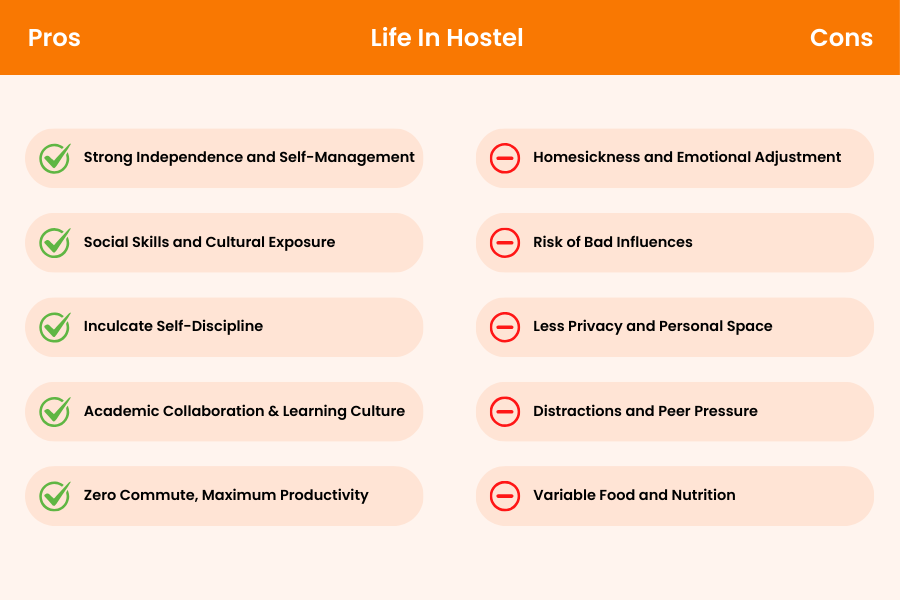
For many students—especially those whose schools or colleges are far from home or in places where local schooling isn’t that good- hostel life becomes a defining phase of their lives. They get a structured setting where daily routines, responsibilities, and social interactions become part of their lives. This kind of setup often accelerates emotional independence and resilience, encouraging students to manage schedules, personal care, and academics. Yet, just as home life is not without its imperfections, hostel living is not either, as mentioned below:
Pros of Life at Hostel
1. Strong Independence and Self-Management
Hostel life makes you independent, as you are not under your parents’ direct supervision. From managing their wake-up times and study routines to handling laundry and personal care, hostellers learn daily skills that they
2. Social Skills, Networking, and Cultural Exposure
Living with peers from diverse backgrounds promotes communication skills, cultural understanding, and teamwork. Group studies, communal activities, and peer support foster deeper social engagement that students often carry forward as lifelong friendships.
3. Inculcate Self-Discipline
Success is determined by many factors, including skills, habits, and attitudes, but the most crucial factor is self-discipline. A self-disciplined man can withstand hardships, temptations, and obstacles to relentlessly pursue the set goal systematically. Residential schools teach students to be independent, to respect one another, to work as a team, and to be disciplined and responsible for their actions, both on and off campus.
4. Academic Collaboration and Learning Culture
Proximity to study groups, shared libraries, and a community focused on learning can enhance academic motivation. Seeing peers studying, clearing doubts, and tutoring one another makes learning more dynamic.
5. Zero Commute, Maximum Productivity:
Hostel students stay at the school dormitories or nearby, thus they save significant hours for rest, sports, or last-minute group study.
Cons of Life at Hostel
1. Homesickness and Emotional Adjustment
Being away from family and familiar surroundings can trigger homesickness, especially in the early months. Students must develop new support systems among peers and staff to navigate this initial emotional strain.
2. Risk of Bad Influences
In some hostels, students often go for late-night outings, substance exposure, and toxic seniors — these exist, especially in poorly supervised hostels.
3. Less Privacy and Personal Space
Shared facilities may cause discomfort to a few children and cause breakdowns. Sharing bedrooms, bathrooms, or common areas can limit personal space and privacy. Adjusting to close quarters with roommates can be challenging for students who value independence or quiet time.
4. Distractions and Peer Pressure
Social life in hostels can sometimes distract students from their academic goals. Without strong self-discipline, lively social environments and routines may compete with study priorities.
5. Variable Food and Nutrition
Compared to home-cooked meals, hostel food may not always meet personal taste or nutritional preferences. Students often have to adapt their diets, which can affect energy levels or health if not managed well.
The Real Difference Lies in the Child, Not the Setting
his is where most discussions miss the point. A confident, curious child may flourish in a residential environment, while a sensitive, emotionally expressive child may initially do better at home.
Age, maturity level, temperament, and learning style matter far more than the label “hostel” or “home.” Ask yourself:
- Is my child comfortable with routines?
- Can they express emotions openly?
- Do they seek independence or reassurance?
- Do they adapt easily to new environments?
There is no weakness in choosing home life
There is no superiority in choosing hostel life
The right choice aligns with the child’s readiness—not societal pressure.
Final Thoughts: It’s Not About Better or Worse—It’s About Readiness
Home life and hostel life are two valid paths, not competing ones. What truly matters is how supported, understood, and guided the child feels in that environment.
Some children grow strong wings at home. Some discover them only after leaving it.
As parents, the goal is not to choose what looks impressive—but rather to choose what builds confidence, resilience, and clarity for the future. And sometimes, the best decision is not permanent. It evolves—as the child does.
For parents who feel hostel life may suit their child—but still want reassurance around safety, structure, and emotional support—the choice of school becomes critical. Well-managed residential schools focus not just on academics, but also on discipline, pastoral care, and gradual independence. Schools such as JAIN International Residential School, Bengaluru, Birla Public School, Kishangarh, Sanjay Ghodawat International School Pune, Macro Vision Academy Burhanpur, Hayde Heritage Kotdwar, and Baluni Public School Kotdwar, are often explored by parents for their structured boarding environments and balanced approach to student development.
If you need more insights into a hostel, we’ve compiled a list of the best boarding schools of India with top facilities so your child can enjoy hostel life to the fullest. Do check it out… For more details, get in touch with us.
Some More Schools with Good Residential Facilities
- JAIN International Residential School, Bengaluru
- Macro Vision Academy, Burhanpur
- DAV Sr. Sec Public School, New Shimla
- Madhusthali Vidyapeeth, Madhupur, Jharkhand
- Cardinal Warrior School, Raipur
- Manassthali Residential School, Bareilly
Frequently Asked Questions
Is a hostel better than a home for students?
Neither hostel nor home is universally better; both have their own strengths and demerits. But it is better for students who need discipline, independence, peer support, constant collaboration, or motivation, which is often lacking at home.
What are the disadvantages of hostel life?
In hostel life, some students face the following, which is a disadvantage of this life:
- Homesickness and Emotional Adjustment
- Risk of Bad Influences
- Less Privacy and Personal Space
- Distractions and Peer Pressure
- Variable Food and Nutrition
- Rules, routines, and restricted freedom
Is hostel life good for girls?
Yes, hostel life is as good for girls as it is for boys. It's just the safety, support, and specific environment that they need that make a particular hostel good or bad. Mostly, it's taken care of those hostels explicitly meant for girls, hence it makes life very smooth, nurturing, and secure.
Is hostel life good for introverts?
Hostel living inherently demands a certain level of social interaction, which can initially feel overwhelming for introverted students. Typically, hostel rooms are shared, and this can create challenges, especially if a roommate is highly social or has a contrasting personality. However, the opposite can also be true; a supportive roommate who respects personal space and privacy can significantly enhance the experience.
In many instances, introverts thrive in hostels, building their confidence as they learn to navigate social interactions while maintaining their boundaries. With the presence of understanding roommates and opportunities for quiet study, hostel life can become a space for personal growth rather than a source of stress. Ultimately, the quality of life in a hostel depends on the specific environment, the people involved, and the individual’s approach.